







The Registered Financial Planner (RFP) programme was introduced and launched by the former Governor of Bank Negara Malaysia, Y.Bhg. Tan Sri Dato’ Sri Dr. Zeti Akhtar Aziz in November 2002.
The RFP designation has been approved by the Bank Negara Malaysia in March 2005 as the qualification to apply for the Financial Advisers’ License and Financial Advisers’ Representative License under the Insurance Act 1996. The RFP designation has also been approved by the Securities Commission Malaysia in November 2005 as one of the qualification to apply for the Investment Advisers License under The Securities Industry Act 1983. RFP designation has also been duly approved by the Securities Commission Malaysia for the application of the Capital Markets Services License (CMSL) in view of the introduction of the Capital Markets and Services Act 2007.
The RFP serves as a mechanism for the MFPC to help fulfill the National objectives of making Malaysia a Centre of Education Excellence. The RFP signifies the twin pillars of professionalism in financial planning – Professional Education and Practice Excellence. Most Importantly, the concept of the RFPs is defined by Malaysians who understand our values and needs.
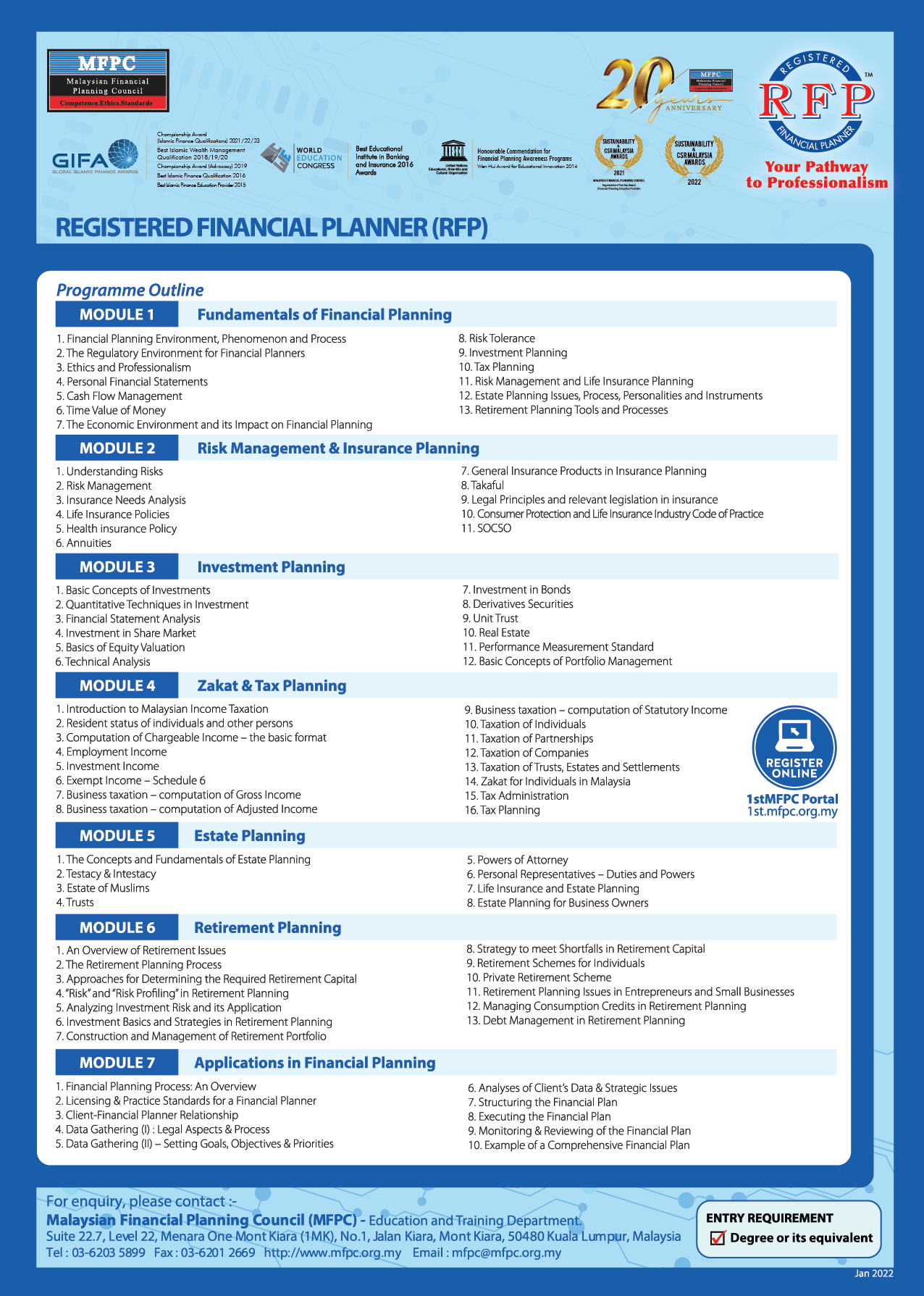
RFP Programme Module
| Module | Descriptions |
|---|---|
| Module 1 | Fundamentals of Financial Planning |
| Module 2 | Risk Management & Insurance Planning |
| Module 3 | Investment Planning |
| Module 4 | Zakat & Tax Planning |
| Module 5 | Estate Planning |
| Module 6 | Retirement Planning |
| Module 7 | Applications in Financial Planning |
Methods of Study
There will be two methods of study allowed:
1) Self-study with examination
2) Course with lectures and examination (Physical)
Upon enrolment for either method of study, a complete set of textbooks /course materials will be given for each and every module.
The text materials used will meet the high standards set by the Certification and Continuing Professional Development (CPD) Board of the MFPC. Candidates will be tested on both the academic and practitioner’s aspects of each module to ensure that RFP designees are those who are trained to perform the task of financial planning in the real world.
Difference Between Self-study and Lectured Courses